Anna Bochkova
-
Journey
is an international artist whose practice explores the intersection of sculpture, installation, and collaborative dialogue. She holds a Master of Fine Arts in Sculpture from the Academy of Fine Arts Vienna (studying under Heimo Zobernig) and a Master of Fine Arts from the Hochschule für bildende Künste (HFBK) Hamburg (under Pia Stadtbäumer).
Bochkova’s institutional presence spans prestigious international venues, including exhibitions at Belvedere 21 (Vienna), Eigen+Art Lab (Berlin), Kunsthaus Hamburg, Galleria Mimmo Scognamiglio (Milan/Verona), Tomáš Umrian Contemporary (Bratislava), the Austrian Cultural Forum (Rome), and the Clemens Sels Museum (Neuss). She is the recipient of numerous awards, grants, and residencies, including the Paper Residency at the Museum Haus des Papiers (Berlin, 2025), the stART.up scholarship from the Claussen-Simon-Stiftung (2024–2025), and a studio scholarship from the Hamburgischen Kulturstiftung.
-
Practice
In her contemporary practice, the artist interconnects sculpture, spatial installation, and drawing to build imaginative, fragile worlds rich in deep personal and social themes. Her work is characterized by the use of diverse materials—ranging from ceramics and papier-mâché to textiles, wood, and metal. From these, she constructs human yet subtly altered figures and structures, urban complexes, ephemeral vessels, or shells that explore themes of closeness, togetherness, and human resilience. In close dialogue with mythology, historical narratives, and contemporary questions, her objects function as social mediators, creating a tactile space for emotion, sensory encounters, and dialogue within the gallery environment.
-
Exhibition Fragile Utopias
navigates the acute tension between the human psychological imperative for security and the inescapable fragility of the reality in which we find ourselves.
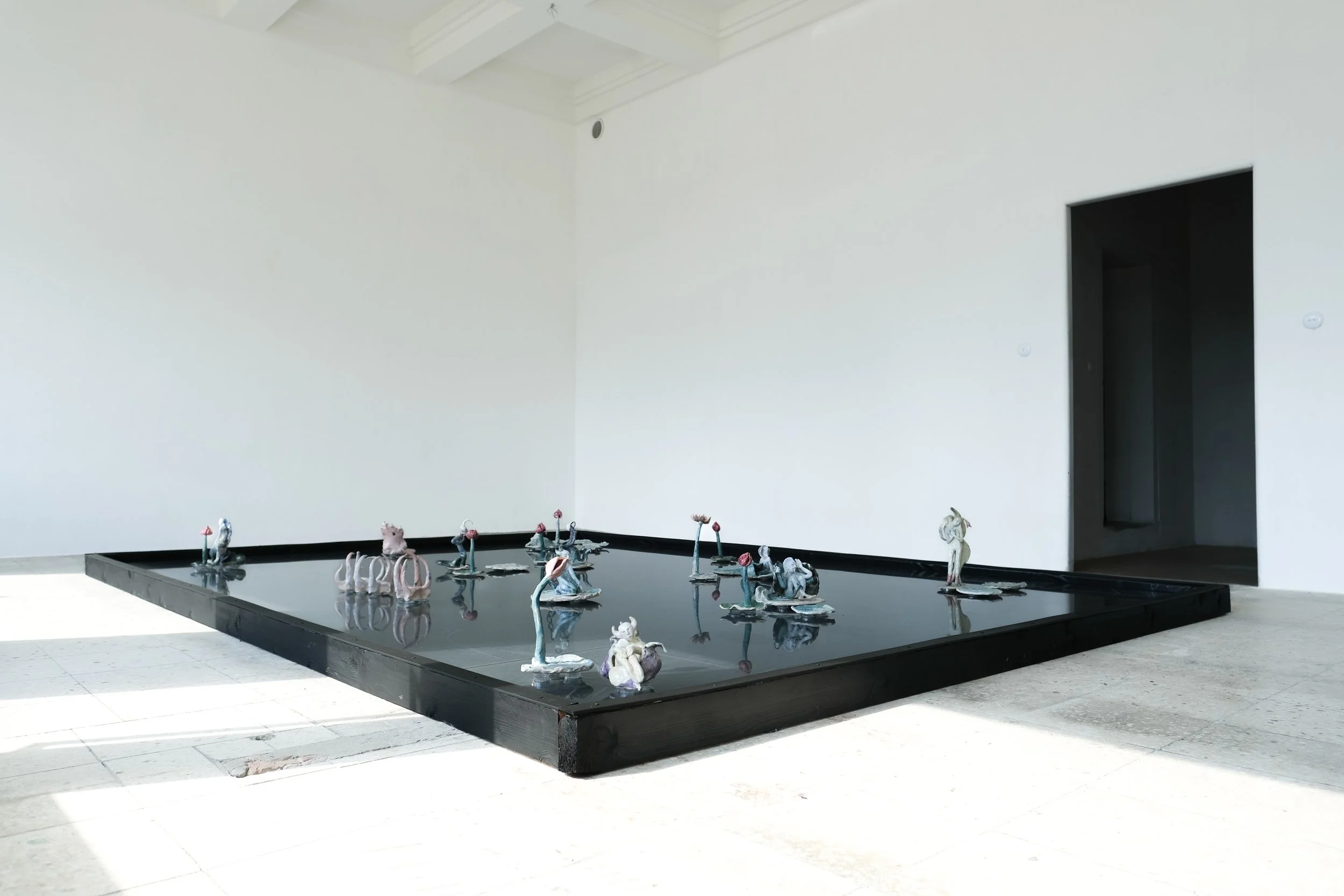
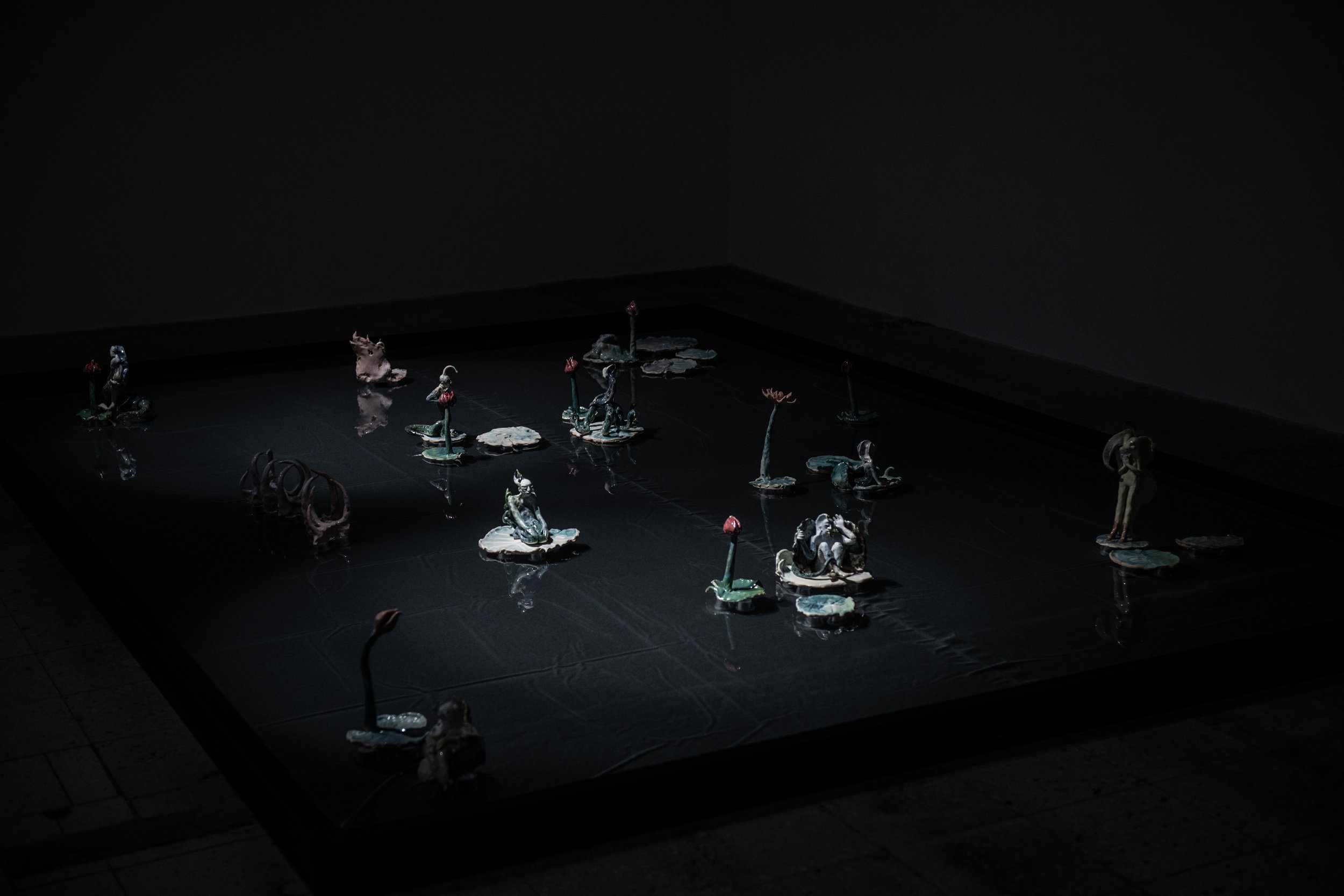
Bochkova’s artistic practice operates simultaneously as an aesthetic object and a social mediator, through which she proposes tactile spaces for deep emotional and sensory encounters. This phenomenon is further amplified by black pools that reflect the fluid, unstable essence of the works, transforming the gallery into a shifting, mirrored ecosystem. These floating ceramic human forms— poetically altered and often profoundly alienated—reflect the figures of our own days.
At its core, Fragile Utopias addresses empathy not as a passive sentiment, but as a mobilized, vital force essential for designing possible futures through the thoughtfully articulated gestures of objects and structures that actively seek and discover alternative modes of cohabitation and dialogue within the distinct worlds of Fragile Utopias.